
Why GABA Alone Often Isn't Enough for Women
If you are wired at night, waking at 3 a.m., anxious for no clear reason, or feeling like your brain will not shut off, you have probably been told to try GABA. GABA is the brain's main inhibitory neurotransmitter, so the logic seems simple: low calm, add calm. But in women, calm can involve hormones, energy availability, and glutamate signaling as well as other health factors.
Progesterone, estrogen, insulin, and leptin can influence signaling pathways involving GABA and glutamate. That is why the same symptom, poor sleep and a racing mind, may have different contributors in perimenopause, PCOS, menopause, or a body that is under-fueled. This article walks through the difference between taking GABA and using a multi-ingredient relaxation formula like GAD Stabilizer, and what is happening in the female brain across different hormonal stages.
Glutamate, GABA, and the GAD Enzyme: The Accelerator and the Brake

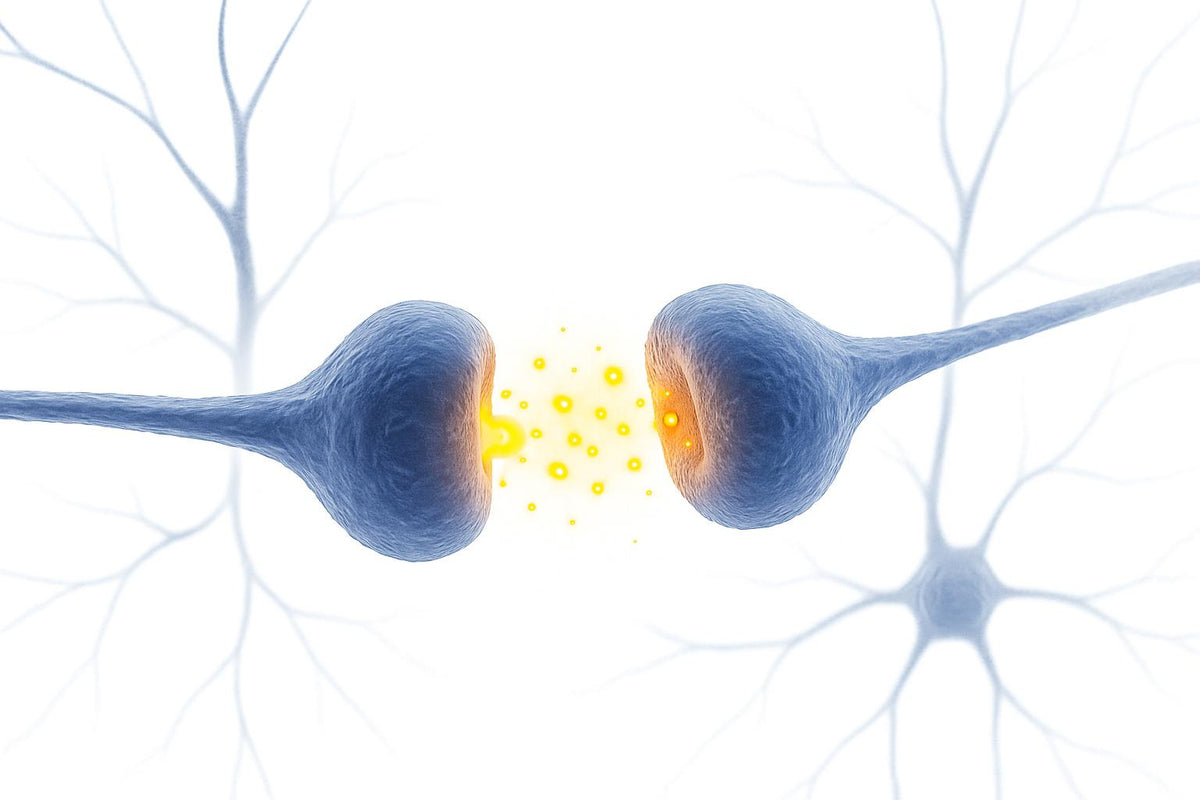
Your nervous system runs on a balance between two signals. Glutamate is the accelerator: it excites neurons, drives alertness, learning, and focus. GABA is the brake: it quiets neurons, allows sleep, and lowers anxiety. Healthy brain function depends on carefully regulated signaling in different circuits, not one measurable whole-brain ratio.
The two are directly connected. Your neurons make GABA from glutamate using an enzyme called glutamic acid decarboxylase, or GAD. GAD requires the active form of vitamin B6, pyridoxal-5'-phosphate (P5P), to work. This is an important biochemical pathway, but it does not establish that an oral supplement changes brain GAD activity, lowers glutamate levels, or raises GABA levels in humans.
Changes in these pathways are one area of research, but symptoms alone cannot establish high glutamate or low GABA. Women may describe racing thoughts, tension, light and fragmented sleep, sensitivity to stress, and a body that never quite downshifts. Excessive glutamate signaling can be harmful in certain neurological contexts, but that should not be assumed from everyday sleep or stress symptoms.
GABA Supplement vs. GAD Stabilizer: What's the Difference?
A GABA supplement provides the calming messenger itself. How much oral GABA reaches the brain is still debated in the research, because GABA does not cross the blood-brain barrier easily. Potential effects outside the brain and through gut-brain pathways are being studied, but the evidence is not conclusive. Oral GABA has not been established as a treatment for anxiety or insomnia.
GAD Stabilizer takes a different approach. Instead of supplying GABA, it combines nutrients and botanicals selected to support normal nervous-system function, relaxation, and a calm mood. Its effects on brain glutamate or GAD activity have not been clinically established. Each two-capsule serving contains:
| Ingredient | Amount per serving | Role in the formula |
| Magnesium (as magnesium orotate) | 35 mg | Essential mineral involved in normal nervous-system function and relaxation |
| Zinc (as zinc picolinate) | 10 mg | Essential mineral involved in normal cellular and enzyme function |
| L-glycine | 500 mg | An amino acid involved in normal physiological signaling |
| L-theanine | 300 mg | An amino acid studied for relaxation and responses to occasional stress |
| Kava kava root (Piper methysticum) | 150 mg | A traditional botanical associated with relaxation; important liver-safety cautions apply |
Simply stated: GABA supplies the signal. GAD Stabilizer is a multi-ingredient formula designed for nutritional support of relaxation; the product name does not mean it supplies the GAD enzyme.
A note on kava: the FDA has issued a consumer advisory about rare reports of serious liver injury with kava-containing products. Do not use a kava-containing product if you have liver disease, or in combination with alcohol or other sedating substances. Avoid during pregnancy or breastfeeding. If you are trying to conceive, taking prescriptions (including hormone therapy), or have any health condition, ask your clinician before use.
How Progesterone Affects GABA: The Allopregnanolone Connection

Progesterone is one of the most powerful calming hormones in the female body, and most of that effect comes from what it turns into. The body converts progesterone, through the enzymes 5-alpha-reductase and 3-alpha-HSD, into a neurosteroid called allopregnanolone. Allopregnanolone binds GABA-A receptors at a site separate from where medications like benzodiazepines bind, and it makes those receptors respond more strongly to GABA.
Allopregnanolone acts especially on a group of receptors outside the synapse that set tonic inhibition: the steady, background calm of the nervous system, as opposed to individual on-off signals. Changes in progesterone and neurosteroid signaling may affect this system, although the response varies by individual and hormonal stage.
The form of progesterone matters too. Oral micronized progesterone passes through the liver first, which produces much more allopregnanolone than progesterone applied to the skin. That may contribute to its sleep-related effects in some patients, but treatment decisions are individualized. If you take prescription progesterone, talk with your prescriber before adding any supplement that also supports relaxation, since the effects can add together.
Perimenopause, Sleep, and Mood: When GABA Becomes Unstable
Perimenopause is not a steady decline. It is fluctuation. Ovulation becomes irregular, so some cycles produce progesterone and others produce very little, while estrogen can swing higher than ever before dropping. Those shifts can change allopregnanolone exposure and GABA-A receptor signaling in complex ways.
GABA-A receptors also adapt. When progesterone withdraws suddenly, receptor responsiveness may also adapt. Hormone fluctuations may be one contributor to new sleep disruption, early-morning waking, irritability, and a lower tolerance for stress, although hot flashes, sleep disorders, and other factors also deserve attention.
Because the hormonal signal is unpredictable, many women look for steady nutritional support for relaxation and sleep during this transition. Nutrients such as magnesium, glycine, and L-theanine support restful sleep and a calm mood, and they work through pathways that do not depend on progesterone levels.
PCOS and Low Progesterone: Why the Brain Gets Caught in a Loop

In polycystic ovary syndrome (PCOS), low progesterone is usually not the starting problem. It is a consequence of not ovulating. Insulin resistance and higher androgen levels can contribute to ovulatory dysfunction in many—but not all—women with PCOS. When ovulation does not occur, there is no corpus luteum to produce the usual post-ovulation rise in progesterone.
The hormonal and neurological picture is more complex than a simple progesterone deficiency. Altered GnRH signaling and ovarian androgen production are part of PCOS physiology, while irregular ovulation can change progesterone and allopregnanolone exposure. Sleep and mood concerns deserve separate assessment; they cannot be attributed to low brain GABA based on PCOS alone.
There is also a twist. GnRH neurons are unusual: GABA can excite them rather than calm them, because of how they handle chloride. Some experimental PCOS research suggests altered GABA signaling in reproductive circuits, but findings cannot be used to infer an individual woman’s brain GABA level. In other words, the GABA story in PCOS is not simply "too little." It depends on where in the brain you look. PCOS is a medical condition that should be diagnosed and managed with your physician, and hormonal and metabolic care is the foundation. Fertility is not determined by GABA levels; irregular ovulation or difficulty conceiving should be evaluated with a clinician, including relevant metabolic and reproductive factors.
Menopause, GABA, and Glutamate: What Changes When Hormones Stop
In menopause, progesterone and estrogen are both low and stay low. That removes two separate supports for calm. Progesterone-derived allopregnanolone is generally lower after menopause, though neurosteroid biology is not an on-off switch. Estrogen's role is less well known: estradiol increases production of the GAD enzyme that makes GABA, maintains the transporters that clear glutamate from the synapse, and supports energy production in brain mitochondria. These pathways may change as estrogen declines, but the evidence does not show that every woman develops a glutamate buildup or GABA deficiency.
The experience varies from woman to woman. Many women notice lighter sleep, waking in the early morning hours, and feeling more reactive to stress.
Hot flashes come from a nearby circuit. Without estrogen feedback, a group of hypothalamic neurons called KNDy neurons (kisspeptin, neurokinin B, dynorphin) becomes overactive and narrows the brain's comfortable temperature range, so small changes trigger a flush. This is an active area of research; hot flashes should not be presented as a proven GABA deficiency.
During this life stage, glycine is a nutrient worth knowing: it supports restful sleep and helps the body's natural drop in core temperature at night. Magnesium and L-theanine support relaxation and help the body respond to occasional stress. If you use hormone therapy, your prescriber can help you decide how nutritional support fits alongside it.
Low Leptin and the Hypothalamus: When GABA Becomes the Brake on Hormones
Leptin is the hormone fat tissue uses to tell the brain how much energy is available. When a woman is under-fueled, whether from undereating, heavy training, or high stress, leptin falls and the hypothalamus reads the signal as scarcity. This pattern is the opposite of PCOS: instead of GnRH running too fast, it slows or stops.
GABA sits at the center of this. In the arcuate nucleus, low leptin quiets the satiety neurons (POMC) and activates the hunger neurons (AgRP/NPY). AgRP neurons release GABA, which inhibits the satiety neurons and dampens the kisspeptin signal that drives GnRH. In functional hypothalamic suppression, GnRH and downstream reproductive hormones can decline, disrupting ovulation. Stress and metabolic adaptations may also contribute.
The priority is identifying and treating the cause of low energy availability, not assuming a whole-brain GABA imbalance. Adequate total nutrition and adjustments to activity may help restore reproductive function under clinical guidance; no specific food or supplement guarantees that result. Loss of a period is a medical concern that should be evaluated by your physician, especially because low estrogen affects bone density.
Frequently Asked Questions
Is GABA or GAD Stabilizer better for sleep? They work differently. GABA supplies the calming messenger directly. GAD Stabilizer combines magnesium, zinc, glycine, L-theanine, and kava for nutritional support of relaxation and restful sleep; it has not been shown to correct a measured brain neurotransmitter imbalance.
Can I take GAD Stabilizer with progesterone or hormone therapy? Talk with your prescriber first. Progesterone and kava both support relaxation through GABA-A receptors, and the effects can add together.
Why do hormones affect anxiety and sleep? Progesterone converts to allopregnanolone, which strengthens GABA signaling. Estrogen may also influence neurotransmission. Sleep symptoms have multiple possible causes, and individual responses vary.
Who should not take kava? Anyone with liver problems, who drinks alcohol regularly, who takes sedatives or medications that affect the liver, or who is pregnant or nursing should avoid kava unless their physician advises otherwise.
The Bottom Line
Calm in women involves hormones, brain signaling, sleep health, and energy status—not just a neurotransmitter dose. Progesterone sets the background calm, estrogen supports GABA production and glutamate clearance, and leptin tells the brain whether it is safe to run the reproductive system at all. Oral GABA and the multi-ingredient GAD Stabilizer formula are different approaches, but neither should be described as clinically proven to rebalance glutamate or treat hormone-related conditions.
Energy over inflammation is the basic equation.
© Courtney Hunt, MD, 2026
Disclosure: Dr. Courtney Hunt is the founder of Genetic Protocol and has a financial interest in the products mentioned in this article.
These statements have not been evaluated by the Food and Drug Administration. This product is not intended to diagnose, treat, cure, or prevent any disease. This article is for educational purposes and is not medical advice. Consult your healthcare provider before starting any supplement, especially if you are pregnant, nursing, taking medication, or have a medical condition.
Featured Product: GAD Stabilizer

Explore the product discussed in this article. Visit the product page for details, current pricing, and purchasing options.


Leave a comment
This site is protected by hCaptcha and the hCaptcha Privacy Policy and Terms of Service apply.